Written Monday, Jan 2: I am finally home after two weeks of travel. We got back last night around midnight from our fantastic weekend in New York after ringing in the New Year in style, and spending all of New Years' Day drinking mimosas and playing Skee Ball at Ace. It was a perfect way to begin 2012, and the perfect end to the last two weeks of adventure.
In a fit of productivity today, I did four loads of laundry, cleaned my room, unpacked my suitcase(s), went grocery shopping, uploaded 400 photos, and will now begin the epic task of blogging our trip. Also, it's 7:15 and I'm ready for bed.
We arrived in Istanbul around 10:30am, Eastern European Time (3:30am to our body clocks), and lucked into a near-empty airport. Both BWI and JFK had been nightmarish the day prior - we'd thought we were so clever to book flights out on that Tuesday afternoon, nearly a week before Christmas. Not so. It seems to me that nobody went to work at all that week. Instead, everyone else had the genius idea to get a jump start on holiday travel. We waited in a lot of lines.
But the primarily Muslim city of Istanbul was abuzz in its regular weekday flow, which left the airport pretty vacant. We paid our $20 apiece for 90-day visiting visas, and were rewarded with a comedian border patrolman who looked at my passport, looked gravely at me, shook his head and said, "WANTED," and then winked cheekily. But not before I felt a tightening in my chest that indicated the onset of a minor heart attack. Hilarious.
We had already changed money at JFK, and so followed signs to the metro. Purchasing tokens was slightly complicated given that nothing was in English, and we couldn't figure out if purchasing double the amount meant tokens enough for two people. A kind man, fluent in both Turkish and English, came to the rescue, inserted our money for us, and handed us the tokens that came out the bottom of the machine.
The metro was a cozy little ride; something akin to this.
Halfway to downtown, we got caught in some nasty traffic due to an intense, albeit entirely peaceful, demonstration that involved hundreds upon hundreds of marchers with signs lining the streets, and an equal number of Turkish police in full riot gear. Having only been in Istanbul for approximately an hour and a half, my Arabic was not quite yet fluent and so I was unable to decipher the cries and signs. I'm pretty sure the demonstration was labor-related, although it could just as easily been a show of despair at the sanctity of marriage pissed upon by the Kardashian family. Either one of those seem to garner intense opinions.
 After
After peeling ourselves from the metro car windows disembarking at Sirkeci, the last stop before the Galata Bridge, we heard the first of many, many muezzin that would form a soundtrack to our stay in the Middle East. The calls to prayer sound discordant at first, and even jarring. But after a careful listen, you can begin to hear the melodic flow and appreciate the precision of vocal control and the beauty of a faith that calls for reflection five times a day. Not all muezzins are created equal, however, and some are more aurally aesthetic than others. But the experience is the same, and it never failed to cause me to stop and listen in the week that we were abroad.

 We lucked into an absolutely beautiful day in Istanbul that day - the weather had called for upper forties, rain, possibly thunder showers. Instead, we got mid- to upper-50s and completely clear skies. The weather beckoned us to the Galata Bridge where we wandered to find a spot outdoors for lunch.
Running along the underside span of the bridge is a row of restaurants, each with menus proudly displayed alongside maître d's who will beg you to sample their wares, look at how fresh their fish is, and bargain with them for a deal on some fish and vegetables. They will run alongside, pushing the menu at you, declaring their feasts to be the best. Eventually, you will tire of shaking your head, and you will select a restaurant not because the menu looks the best or the fish looks the freshest, but because a maître d' has worn you into submission and you're simply too tired and hungry to go on.
When I say that this fish is fresh, I am not kidding you. You will be invited to peruse their wooden crates of whatever was brought in that morning, and you will look at row after row of glassy-eyed fish and select one. You tell the chef how you'd like it prepared (sauteed, fried, filleted, whole, grilled, however you like! We make for you!), and you sit down and allow for a rush of hospitality so detailed, they might as well work your jaw for you to chew your food.
The Gentleman and I chose Shepherd's salad
(fresh tomatoes, cucumbers, onions, and radishes in a light-as-air vinegar and oil dressing), fatty tuna with capers, a platter of fresh fruit, and bottled water to start. We selected three exquisite bluefish from a wooden crate filled with ice chips, and asked for them to be grilled and served whole. While eating our salad and appetizers and waiting for our meal, we basked in the warm sunshine and tried to fight off dizzying jet lag. Fishers on the bridge above lined the walkway with lines, cast out into the bright blue, churning Bosphorus River. I half-wondered if a fish drawn right in front of us would end up on our plates.
 A young Turkish lad wearing pants like a Newsie and an Armani jacket strolled up with a wheelbarrow packed with shaved ice and fish. I shit you not. The maître d' came outside, and manhandled a few of the fish with a practiced eye, before shouting a stream of words that were either condemning the fish seller to hell or proclaiming these fish to be bigger than Justin Bieber. He motioned towards us.
"You want fish? Fresh? You want try? My chef cook for you, however you like. You pick the fish. We cook it." We looked at the dead fish nestled snugly in the wheelbarrow of ice and politely declined. We'd already done our selecting for the day.
And, let me tell you, the fish that was brought to us was a work of art. So simply cooked, without so much as salt and pepper, but delicately buttered and sprinkled with lemon, it fell right off the bone. The papery skin melted like puff pastry around the succulent meat. We shared three of the tiny fish and felt completed sated.
We ordered baclava and Turkish coffee for dessert and were presented with a strange, grainy nut composition. My first Turkish coffee in Istanbul still sits in my memory as one of the best things I've ever tasted. We asked for no sugar, as coffee and tea in Turkey and the Middle East tend to come heavily sugared. This coffee needs no sugar, no milk. It is stark, rich, almost buttery, with only the slightest, enjoyable bitterness at the end. My jet lag was at bay after that coffee, and this began an unfortunate wanton lust for Turkish coffee that lasted throughout the trip to fight off fatigue. Coming back, I am now hooked on caffeine again after kicking my triple-latte-a-day habit, but nothing will satisfy this jones.
Coffee now is disappointing and stupid. My hands shake for the real deal.
We walked off our delicious meal and made our way to the Blue Mosque. We were asked if we were German, British, or Californian. All might have been plausible - with our blonde hair and blue eyes, my boyfriend and I were frequently mistaken as various Nordic nationalities throughout the trip. (Also as brother and sister, but thankfully only when his parents and brother were with us, and they assumed the five white people had to be a family.)
The Blue Mosque was incredible, and disappointing only in that we happened to get there at prayer time, and were not allowed inside. But the courtyard was pretty breathtaking:


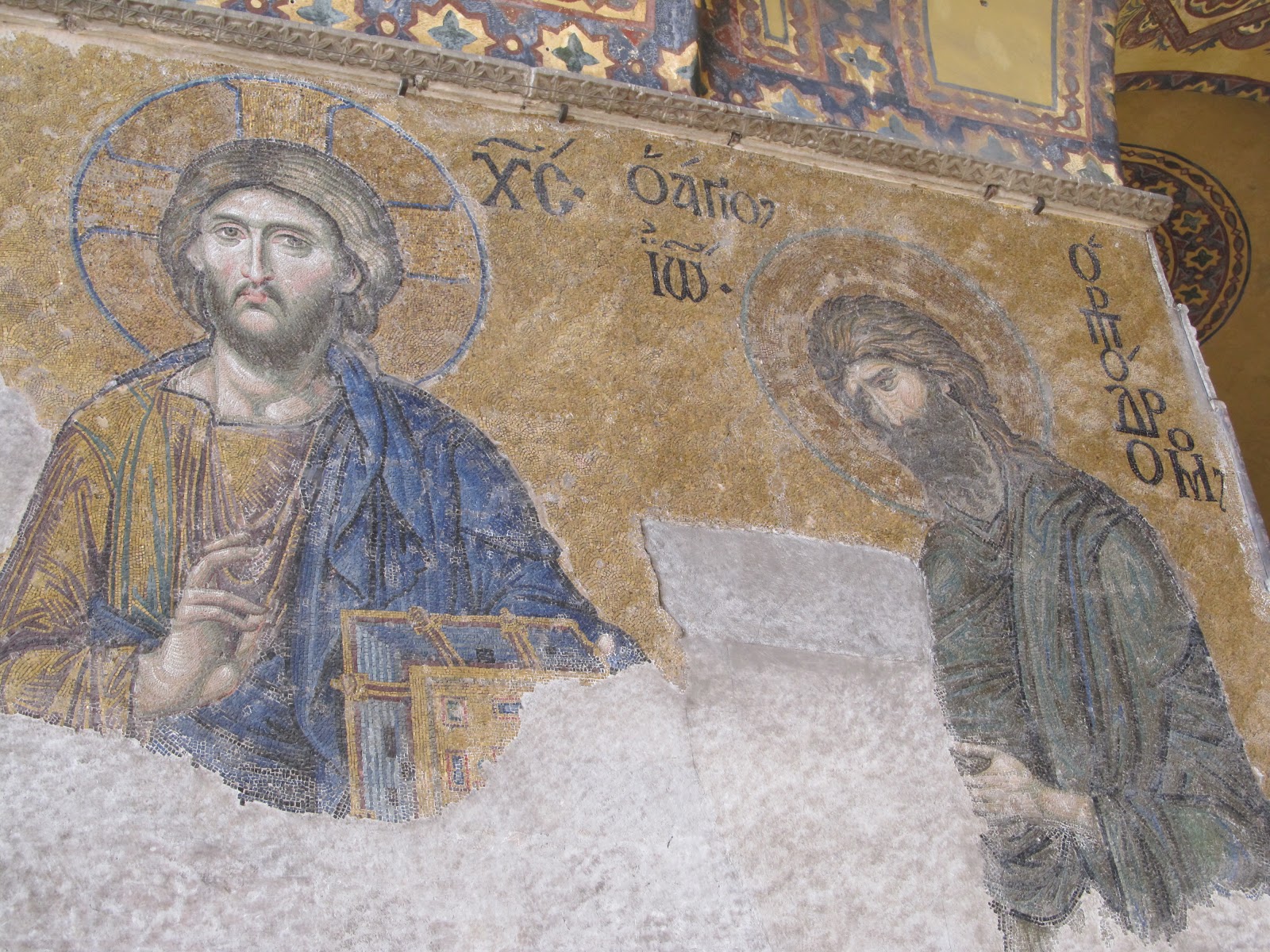
We made our way across the park area to the Hagia Sophia which was further awe-inducing. The Hagia Sophia is an ancient basilica-turned-mosque, and is a jaw-dropping montage of Islamic and Christian motifs, cradled together in towering domes.


In a fit of productivity today, I did four loads of laundry, cleaned my room, unpacked my suitcase(s), went grocery shopping, uploaded 400 photos, and will now begin the epic task of blogging our trip. Also, it's 7:15 and I'm ready for bed.
 |
| The Blue Mosque |
But the primarily Muslim city of Istanbul was abuzz in its regular weekday flow, which left the airport pretty vacant. We paid our $20 apiece for 90-day visiting visas, and were rewarded with a comedian border patrolman who looked at my passport, looked gravely at me, shook his head and said, "WANTED," and then winked cheekily. But not before I felt a tightening in my chest that indicated the onset of a minor heart attack. Hilarious.
 |
| Welcome aboard Turkish airlines! |
 |
| Deceptively empty metro car at one of the early stops. |
The metro was a cozy little ride; something akin to this.
Halfway to downtown, we got caught in some nasty traffic due to an intense, albeit entirely peaceful, demonstration that involved hundreds upon hundreds of marchers with signs lining the streets, and an equal number of Turkish police in full riot gear. Having only been in Istanbul for approximately an hour and a half, my Arabic was not quite yet fluent and so I was unable to decipher the cries and signs. I'm pretty sure the demonstration was labor-related, although it could just as easily been a show of despair at the sanctity of marriage pissed upon by the Kardashian family. Either one of those seem to garner intense opinions.


 |
| Galata Bridge restaurants |
Running along the underside span of the bridge is a row of restaurants, each with menus proudly displayed alongside maître d's who will beg you to sample their wares, look at how fresh their fish is, and bargain with them for a deal on some fish and vegetables. They will run alongside, pushing the menu at you, declaring their feasts to be the best. Eventually, you will tire of shaking your head, and you will select a restaurant not because the menu looks the best or the fish looks the freshest, but because a maître d' has worn you into submission and you're simply too tired and hungry to go on.
When I say that this fish is fresh, I am not kidding you. You will be invited to peruse their wooden crates of whatever was brought in that morning, and you will look at row after row of glassy-eyed fish and select one. You tell the chef how you'd like it prepared (sauteed, fried, filleted, whole, grilled, however you like! We make for you!), and you sit down and allow for a rush of hospitality so detailed, they might as well work your jaw for you to chew your food.
 |
| sauteed spinach, tuna mezze |
 |
| Shepherd's salad |
The Gentleman and I chose Shepherd's salad
(fresh tomatoes, cucumbers, onions, and radishes in a light-as-air vinegar and oil dressing), fatty tuna with capers, a platter of fresh fruit, and bottled water to start. We selected three exquisite bluefish from a wooden crate filled with ice chips, and asked for them to be grilled and served whole. While eating our salad and appetizers and waiting for our meal, we basked in the warm sunshine and tried to fight off dizzying jet lag. Fishers on the bridge above lined the walkway with lines, cast out into the bright blue, churning Bosphorus River. I half-wondered if a fish drawn right in front of us would end up on our plates.

"You want fish? Fresh? You want try? My chef cook for you, however you like. You pick the fish. We cook it." We looked at the dead fish nestled snugly in the wheelbarrow of ice and politely declined. We'd already done our selecting for the day.
 |
| Delectable. And kind of snarly. |
 |
| "Baclava" |
We ordered baclava and Turkish coffee for dessert and were presented with a strange, grainy nut composition. My first Turkish coffee in Istanbul still sits in my memory as one of the best things I've ever tasted. We asked for no sugar, as coffee and tea in Turkey and the Middle East tend to come heavily sugared. This coffee needs no sugar, no milk. It is stark, rich, almost buttery, with only the slightest, enjoyable bitterness at the end. My jet lag was at bay after that coffee, and this began an unfortunate wanton lust for Turkish coffee that lasted throughout the trip to fight off fatigue. Coming back, I am now hooked on caffeine again after kicking my triple-latte-a-day habit, but nothing will satisfy this jones.
Coffee now is disappointing and stupid. My hands shake for the real deal.
 |
| Must. Have. More. |


We made our way across the park area to the Hagia Sophia which was further awe-inducing. The Hagia Sophia is an ancient basilica-turned-mosque, and is a jaw-dropping montage of Islamic and Christian motifs, cradled together in towering domes.




We had to leave Istanbul after only a few hours to catch the flight to Amman. My sincerest wish to spend more time there came true - sort of - but I now have an ardent desire to spend a good week there. So much history in this beautiful city, where the Middle East, Europe, and Asia collide and influence and remain.

Next on the docket: A little spiel about Middle Eastern food, aka "Why Even Whole Foods Now Disappoints."


